The Narrator Leads a Writing Workshop for Human Trafficking Victims
The FriendThe Narrator’s writing workshop for human trafficking victims grows out of an old friendship and a belief in writing’s potential as a form of support. The invitation brings her into a treatment setting where the need for expression is real, but where privacy and participants’ freedom to choose how they write matter as much as the workshop itself.
Invitation and Background
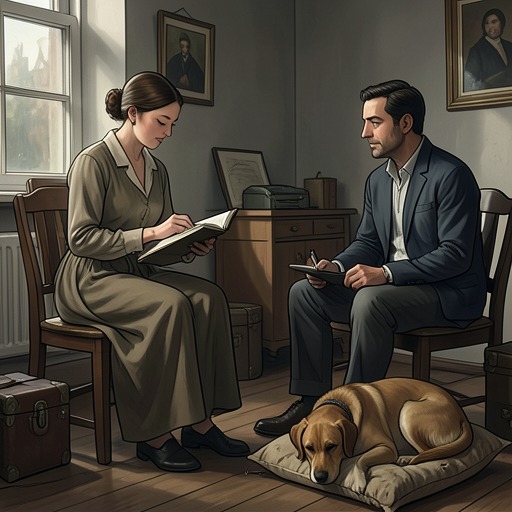
The invitation came from a former college friend who had once hoped to become a writer but instead trained as a psychologist. For ten years she had worked at a treatment center for victims of human trafficking, connected to a large psychiatric hospital a short bus ride from Manhattan, New York City. The women there had responded well to art therapy, and the psychologist thought writing might also be helpful, as it had been for other people affected by trauma. The Narrator wanted to accept for three related reasons: community service, a favor to an old friend, and her own identity as a writer.
Journaling and the Conditions of Participation
Before the workshop, the psychologist encouraged the women at the center to keep journals, emphasizing that the writing was private: she would not read it, and neither would anyone else. Some participants hid their journals; others carried them everywhere. A few chose to destroy what they had written immediately or soon afterward, a choice the psychologist accepted. Those who were more comfortable writing in a language other than English were encouraged to use their native tongue. The practice was structured around control over whether to write, what to write, and whether the words would remain.
Not everyone wanted to journal. The psychologist explained that asking participants to revisit painful experiences could provoke anger, and that the harm in many of their lives had begun before trafficking. An end to the abuse did not mean an end to its effects. Some participants described death as the best thing that could happen to them, underscoring the seriousness of the distress the workshop would have to meet without assuming that writing itself could resolve it.
A group of women, however, had taken readily to journaling and often wrote for much longer than fifteen minutes a day. The psychologist wanted to give them a workshop where they could write and share with one another and an instructor. Although some were not native English speakers, the participants who had signed up had a sufficient level of English for the group; even those who spoke it natively worried about spelling and grammar. The psychologist asked the Narrator to set those concerns aside so that correction would not undermine participants already struggling with self-esteem. The workshop’s first practical rule was therefore not a literary standard but permission to write without being judged for errors.
Images, Testimony, and the Ethics of Representation
The psychologist showed the Narrator examples of artwork made by women at the center. The drawings conveyed experiences of danger and trauma through stark, disturbing images; recorded testimony gave those images further context. The encounter made the proposed workshop more than an exercise in writing technique: it placed the Narrator before accounts of suffering that required attention, while leaving open what writing could or could not do for the people who had endured it.
The psychologist also described a fourteen-year-old who had recently been rescued after being held captive. The girl could not speak, although doctors had found no problem with her vocal organs. The psychologist understood this as a possible psychosomatic response, alongside other symptoms the center encountered, including blindness and paralysis. Her account emphasized that severe harm could restrict expression itself; a writing workshop could offer an opportunity to communicate, but could not presume that every participant would be able or willing to use it.
That distinction shaped the Narrator’s obligations as a writer. She promised not to use anything the women wrote in the workshop. The psychologist, by contrast, agreed to let the Narrator write about her and her work. The Narrator’s friend then presented the idea to an editor, and a contract and deadline followed. The arrangement separated the women’s private writing from the account that could be published, making consent and the limits of representation part of the project’s conditions.
Later Echoes: Writing, Witness, and Its Limits
The workshop’s emphasis on choice and nonjudgment finds an echo elsewhere in the Narrator’s account of writing as a shared practice. In a later report from a psychiatric ward, a participant describes a group-therapy poetry workshop led by a recreational therapist: patients wrote poems rather than prose because time was limited, then read them aloud without analysis or criticism. The writing seemed rough to the speaker, but the chance to share it moved the room; readers’ voices trembled, listeners cried, and each poem received applause. The episode does not establish what the trafficking-center workshop achieved, but it sharpens the distinction between literary evaluation and the immediate human value of being heard.
The Narrator’s reading aloud to Apollo offers a quieter counterpart. She takes Rainer Maria Rilke’s Letters to a Young Poet from a stack of books and reads while Apollo settles against her legs, his ears shifting with her vocal inflections. Unlike music or massage, the reading appears to soothe him, and the Narrator finds the act soothing as well. Set beside the proposed workshop, the scene extends the question of writing beyond instruction or publication: language may create a moment of attention and companionship, but its effects depend on the listener and cannot be guaranteed in advance.